

Webinar Details
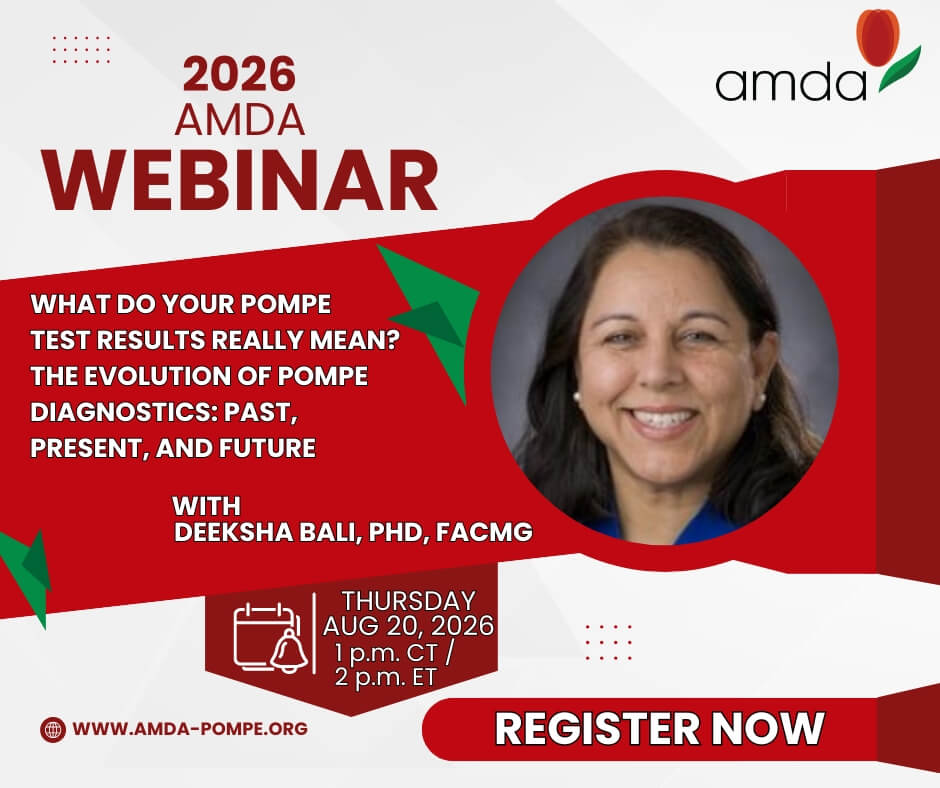
Title: What Do Your Pompe Test Results Really Mean? The Evolution of Pompe Diagnostics: The Past, Present, and Future
Date: Thursday, August 20, 2026
Speaker:
Deeksha Bali, PhD, FACMG
Webinar Overview:
This webinar examines Pompe disease diagnosis in the newborn screening era, drawing on lessons learned since implementation and the growing challenge of novel variants identified each year. It highlights the role of CRIM testing, GAA enzyme and mutation analysis, and urine Hex4 biomarker testing in achieving early, accurate diagnosis. The talk underscores an urgent need for a validated, disease-specific functional assay to characterize variants of unknown significance and support their reclassification, benefiting newly diagnosed patients. It also points to the promise of understanding Pompe disease’s molecular mechanisms to predict disease onset and progression and guide treatment decisions, an unmet need for patients identified through newborn screening.
Disclaimer: The content provided in this webinar is for informational purposes only and does not constitute an endorsement by the AMDA.
Recording or reposting AMDA webinars is prohibited without the AMDA’s prior express written permission. Unauthorized use may result in takedown demands and legal action.
Speaker Biography

Deeksha Bali, PhD, FACMG
Professor, Pediatrics Medical Genetics
Director, Biochemical Genetics Laboratory
Duke Health
For the past 28 years, serving as one of the Laboratory directors of the Duke biochemical genetics laboratory, Dr. Bali has been directly involved with the initial diagnosis of rare diseases like GSDs and common LSDs, using both biochemical and molecular testing methodologies. She has a keen interest in developing new testing methods and improving current available methods for a group of storage diseases like various GSDs, Pompe, Fabry, MPSI and other LSD disorders. The focus of her research and expertise has been the development of non-invasive diagnostic methods for early detection of treatable metabolic disorders, especially lysosomal storage disorders (LSD) like Pompe disease and associated CRIM testing—to gain a better understanding of the disease. Besides methods development, she has a long-standing keen interest in preclinical and clinical work involving GSDII/Pompe disease, GSDIII, GSDIV and GSDIX projects and protocols. Additionally, noninvasive biomarker development and enhancing targeted delivery of enzyme to affected tissues are among her fields of interest. Her experience has resulted in authorship of more than 180 publications in competitive peer-reviewed journals, including multidisciplinary management guidelines. Altogether, Dr. Bali’s current and extensive experience in diagnostics and research associated with Pompe disease provides the appropriate expertise to best support the Pompe community in general.