
While there have been many improvements and protections upheld from the ADA, there is still more work that needs to be done. Anecdotally, a lot of the work needing to be done comes in the form of the general public’s perception of disability — something that no law on its own can fix. So, what do I mean by this? I’ll provide you with some examples to illustrate an overarching experience I’ve dealt with my whole life.
During my school years, there was a building I’d go to where the designated handicap parking slot was not adjacent to a curb cutout. In fact, it was solidly a hundred or so feet away. I am in a powered chair, so it didn’t bother me so much, but it did make me feel a bit confused about their thought process on the location of the curb cutout.
As a working musician, it is imperative that I make sure every venue is wheelchair accessible prior to performing. There have been times that a manager told me their place was accessible only for me to discover upon getting there that the building has a small step that is about four inches. Even a four-inch rise like this will prevent access for someone using a powered wheelchair. Simply put, a step or a ledge is not something that folks without a physical disability have to think about. And, I do not fault them!
When moments like the above scenario happen, I try to remain calm in my approach and explain to folks why something will not work. The adage of catching more flies with honey than vinegar may sound tired, but it is an adage for a reason. If folks on the outside are meant to have the responsibility of understanding the circumstances that people with disabilities face, then it may be beneficial for people with disabilities to maintain calmness when explaining their circumstances if there’s a disconnect happening. If, through a calm tone, understanding is not achieved to the outside party, a more abrasive tone will not help. In those situations — from my experience — it is best to remove yourself from the equation.
There is another scenario I’d like to relay before moving on to a pathway for improving the overall conversation in society. Somewhat recently, while out with a friend, I witnessed a little kid walk up to me and start to ask me what was wrong with me. Before the whole question came out of the kid’s mouth, her mother whisked her away, telling her not to talk like that in public. I understood the mother’s frantic lesson, but in my view, it was a bit misplaced. Despite the question’s phrasing being less than ideal, it did make me chuckle. In fact, I was ready to answer before the mother intervened. I feel that innocent curiosity, such as that in a child, will lead to more productive growth of character, and thus growth of society. During my answer, if I had been given the chance, not only could I have explained what my medical situation is, but I could’ve help teach a better way to ask such a question.
So, what can be done societally to improve the understanding of disability? Dialogue. As a reporter, I recently wrote an article that dealt with a very mentally heavy topic, but a quote came out of the report that has stuck with me ever since I heard it. During our conversation, disability advocate and disability studies professor David Mitchell said, “Our interest in disability is often born from proximity to disability . . .” In essence, Mitchell was describing that those who deal with disability are more invested in it, whether they are personally dealing with or know someone that is.
While the ADA was not a catch-all solution for bias and discrimination, it did inarguably give those with disabilities more of a chance to be more active members of society. Using the empowerment that the ADA gives people in these situations, it is my hope that we can use our presence in society to perpetuate a dialogue that continues to lessen the stigma around disability that only those with one truly know.
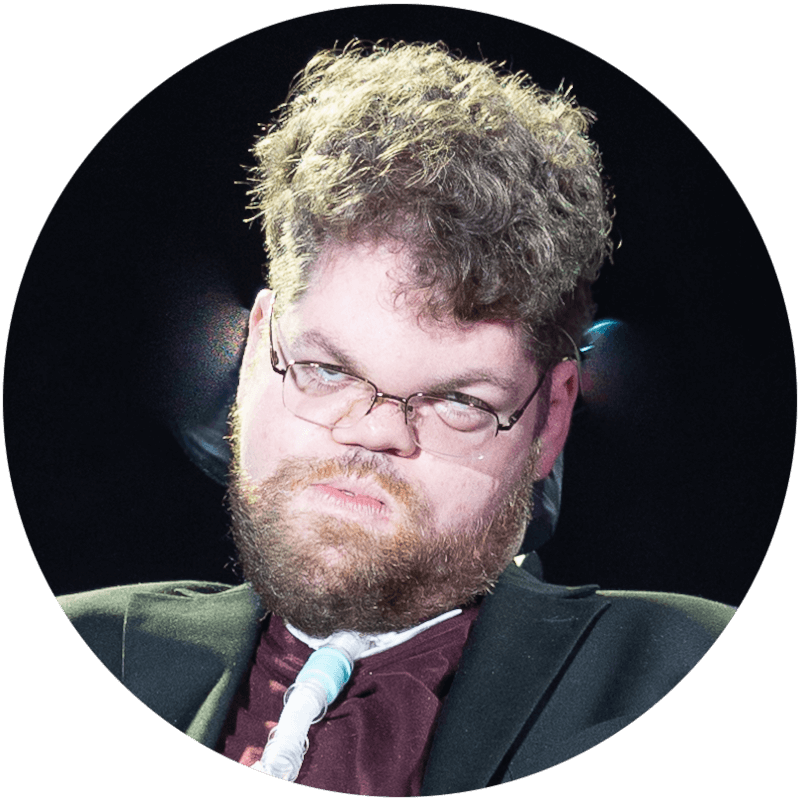
Lucas Garrett
Editor and Community Contributor
Lucas Garrett is an active performing musician, composer, and arranger in upstate New York. In addition to his work in the arts, he serves as a freelance journalist for a local newspaper, covering arts and culture.
Garrett has been living with Pompe disease for over three decades and continues to lead a full and creative life. Prior to joining the AMDA staff, he collaborated with Marsha Zimmerman and Tiffany House on several projects, including working on the AMDA’s Mentoring Program, compiling research articles into the organization’s database, and conceptualizing early AMDA webinar programming.
Lucas is currently enrolled in UC San Diego’s certificate program in copyediting. He holds a bachelor’s degree in applied mathematics from SUNY Empire State (2017) and an associate degree in general science from SUNY Adirondack (2013).