
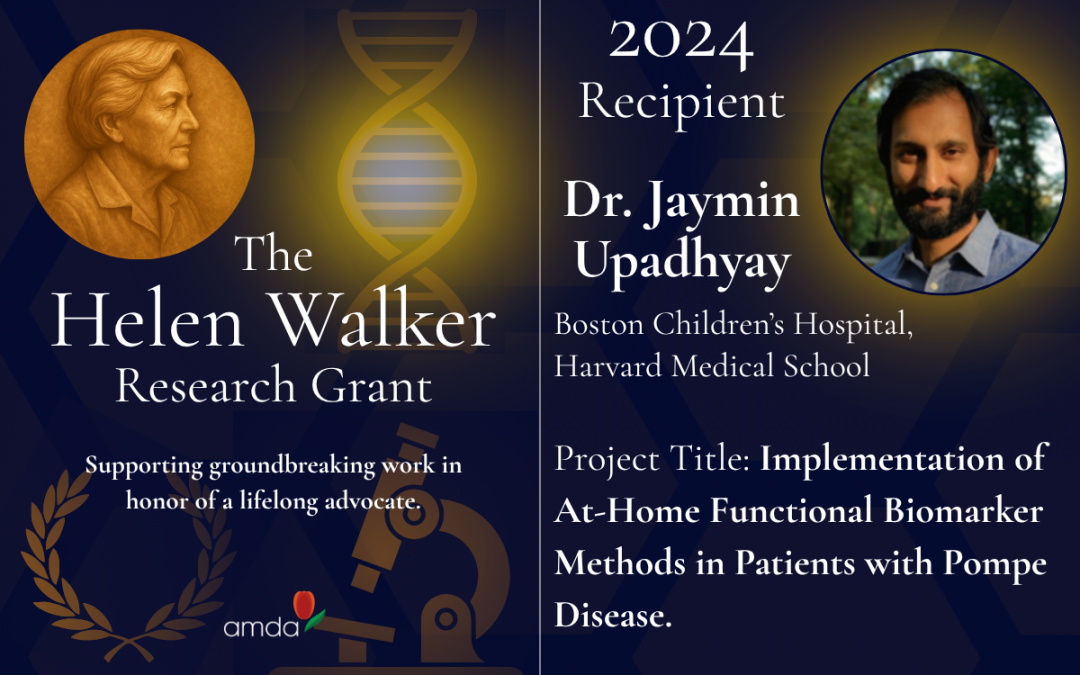
The winner of the 2024 AMDA Helen Walker Research Grant: Dr. Jaymin Upadhyay, Boston Children’s Hospital, Harvard Medical School
Project Title: Implementation of At-Home Functional BiomarkerA measurable sign in the body that helps track disease progression or treatment response. Methods in Patients with Pompe DiseaseA rare genetic disease in which the body cannot properly break down glycogen, leading to buildup that damages muscles and can affect breathing and, in some cases, the heart..
For the second year in a row, the AMDA received a high volume of applications totaling 13. Of these, 5 projects focused on patient follow-up, 7 projects covered different therapeutic approaches, and 1 project aimed at understanding the disease pathophysiology. The proposals were evaluated twice before a final decision was made. In the first round, the reviewers accessed the submissions independently. The winner was chosen in the second round, after re-review followed by an open discussion with AMDA.
The objective of Dr. Jaymin Upadhyay’s proposal is to identify a set of at-home tests to monitor disease progression and response to therapy in both infantile (IOPDA severe form of Pompe disease that begins in infancy and often affects the heart and muscles.) and late onset (LOPDA form of Pompe disease that begins after infancy and usually progresses more slowly.) patients. A test battery is geared to monitor “upper and lower extremity muscle health, speech productionThe ability to form and articulate words., bulbar functioningFunctions involving muscles of the face and throat, including swallowing, speaking, and chewing., motor skills, cognitive ability, (and) respiratory function”.
The AMDA considers the introduction of methods and equipment for home-based follow-up an important development given the increasing number of patients who are currently diagnosed via newborn screening. At present, newborns diagnosed with IOPD are treated with ERT as soon as the circumstances allow. However, the course of the disease in newborns diagnosed with LOPD is uncertain and subtle symptoms may go unnoticed for decades.
Dr. Jaymin Upadhyay and his team propose to investigate the practicality of follow-up in “an entirely at-home setting…to lower the burden (of regular hospital visits) on patients and their caregiver(s)”. The use of commercially available equipment, such as for measuring muscle health, speech performance and respiratory function, as well as ‘NIH Toolbox’ for motor function and cognition may prove applicable for at-home monitoring of Pompe disease progression and treatment effect.
The grant proposal scored highest for its clarity and potentially broad application. We welcome Dr. Upadhyay and his team to the Pompe community.