
May 2026
The following story was written by Courtney, Rachel’s daughter, and submitted to us to share her mother’s experience. We are grateful for her willingness to give us this window into their family’s journey. While we strive to share accurate and helpful information, individual experiences and details may vary and may not reflect current medical guidance.
Bodysnatcher
In 1998, Rachel Foster (Goodwin at the time) was your typical high school senior. She enjoyed hanging out with her friends and playing a variety of varsity sports, including softball, tennis, and swimming for her school. Always keeping busy from fall to summer, as most teenagers in the 90s did. She had an older brother, a younger sister, and two parents who worked full-time to support their family. With two busy parents, this often left her with the job of taking care of her annoying little sister, Darlene. When she wasn’t playing sports, doing schoolwork, or being a teenager, she worked at Nickerbokers, a bar and grill, as a waitress.
Nine years later, she was married, living in the same city she grew up in. Around this time, she and her husband, Tim, moved into her great-grandmother’s house on the same street she grew up on. After working for American Airlines for a few years, she began working as a shipping specialist for CMA CGM and caring for her newborn daughter. When she started experiencing weight gain and weakness and having trouble getting off the ground and climbing stairs, of course, she originally thought what she was going through was typical postpartum symptoms; she just had a baby after all. “Everybody feels this way after just having a baby and putting on extra weight.”
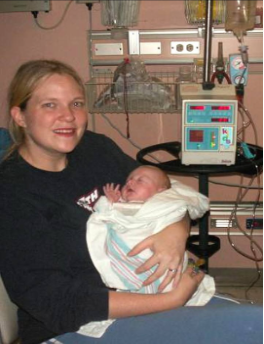
Rachel and her daughter (4 weeks) are pictured at the hospital after the infant was being treated for RSV (respiratory syncytial virus). Circa Nov. 2006
The world kept spinning, and Rachel continued to live and adjust to being a new mom while also experiencing what she thought was normal. One day, when she went to get her medication refilled, she learned that there was an issue with her insurance and that her current doctor was no longer accepting the insurance she currently had. As part of seeing a new doctor, she had to do blood work, which should have been simple and run-of-the-mill. Still, it would soon be the start of an 18-month-long journey of blood work, seeing doctor after doctor, and having no answers as to why she was feeling this weakness and how a healthy 26-year-old who used to play sports and had been fairly healthy and living a normal life up to the point was diagnosed with a rare disease that affected 1 in 40,000 individuals.
Pompe diseaseA rare genetic disease in which the body cannot properly break down glycogen, leading to buildup that damages muscles and can affect breathing and, in some cases, the heart. (not to be confused with the volcanic destruction of the city of Pompeii in 29 CE) is described as a rare genetic disorder caused by a deficiency of the enzymeA protein that helps the body carry out chemical reactions. acid alpha-glucosidase (GAA)The enzyme the body needs to break down glycogen. In Pompe disease, this enzyme is missing or does not work well enough., leading to glycogen buildupThe buildup of glycogen inside cells and tissues when it is not broken down properly. in muscles and other tissues. If you’re anything like me and know nothing about what an enzyme, alpha-glucosidase, is, then I’m glad you’re here because I’ll explain it in simpler terms. When your body lacks GAA (a complex sugar), it can no longer break down substances, which leads to common symptoms such as muscle damage and damage to other organs. In 2008-2009, around the time Rachel was diagnosed, there was little to no information about Pompe. “So at the time of diagnosis, there were no treatments. And I was given a 5-year prognosis that I would be completely wheelchair-bound and on a ventilatorA method of assisting or replacing breathing using a machine that moves air in and out of the lungs. within 5 years.”
With the bloodwork complete, the new doctor noticed elevated enzyme levels in her liver. Before the doctor was comfortable prescribing medicine for the elevated levels, he referred her to a gastroenterologist who specializes in diagnosing and treating diseases of the digestive system. When meeting with the doctor, she had mentioned the difficulty getting up from the bathtub. “And he was just kind of like, hmm, that’s interesting. All the tests and all the workouts he did on his end did not indicate that there was anything.” With the conclusion that nothing was wrong on his end, he referred her to yet another doctor, this time a rheumatologist, who, after consulting her previous symptoms and results, ruled out rheumatoid arthritis, a chronic condition that causes pain, swelling, and irritation, called inflammation, in the joints. But it can also damage other parts of the body. Ruling out RA, the rheumatologist sent her on her way to the next doctor with the conclusion that whatever she was dealing with was neurotic; therefore, the next doctor she saw on her long journey was a neurologist.
At this point, she has consulted doctors of many specialties, who have all ruled out condition after condition, leaving Rachel with more questions than answers. “I’m getting weaker. I’m worried. It’s just becoming harder to do just simple things, pulling a casserole out of the oven or just picking the baby up out of our car seat.” For almost a year, she spent it with that doctor, undergoing so many blood tests to the point her inner elbows were bruised, her inner nose became sensitive to the smell of the alcohol they used to clean equipment, ruling out disorder after disorder, but at the end of this long list was Pompe disease. “It was pretty much a death sentence at that time. And so she did all her work. So I went through so much blood work and so many different muscle conduction tests. And I was given a blanket diagnosis of limb-girdle muscular dystrophy just so that I could start getting support and treatments, such as physical therapy.”
Of course, there are thousands of muscular dystrophies, and we all knew limb-girdle wasn’t going to be the one they stuck with, and so, that’s right, you guessed it, another doctor. All of this while taking care of a quickly growing baby, juggling household needs, and having a full-time job was not only physically straining but also mentally draining; luckily, her parents were right down the street to assist. After a four-hour drive to the University of Virginia Medical Center, they performed a muscle biopsy, which revealed a single bad gene for Pompe disease, but in order to be officially diagnosed, they needed another bad gene, but the second one was hiding — because of course it was.
Another thing you should know about Pompe disease is that it’s hereditary, meaning somewhere down the line of her ancestry, a family member might have been dealing with what she is but possibly with not as much medical guidance. Can you imagine being in so much pain, going to doctors, and coming back with no answers for months and seemingly no end to your suffering?
After UVA couldn’t find the other bad gene, they sent her four hours the other way, and she was referred to Duke University’s Dr. Priya Sunil Kishnani, whose entire focus was on Pompe disease, and after more tests, the second bad gene, less common but more seen in late-onset cases, in October of 2008, Rachel was finally, officially, diagnosed with Pompe disease. Of course, as mentioned before, at this time there was no cure, and the trial treatment was closed. There was light at the end of the long…long tunnel, and it was called LumizymeA form of enzyme replacement therapy used to treat Pompe disease by providing a lab-made version of the GAA enzyme., a brand new medication that replaces a missing or deficient enzyme in people with Pompe disease. When the trials for Lumizyme entered phase two, Rachel was able to start on the medication in December of 2009, which would save her life.
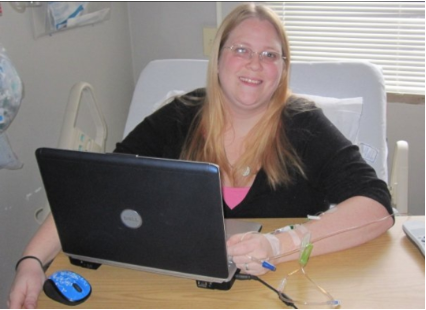
Rachel, pictured during one of her infusion therapies, circa 2010. She received these infusion therapies in a hospital setting every two weeks.
Lumizyme luckily passed all required drug trials and was approved by the FDA in May of 2010. Rachel remained on Lumizyme until January 2023, when the same drug company produced a second-generation drug named NexviazymeA newer enzyme replacement therapy designed to improve delivery of the enzyme to muscle cells.. Funny, right? She continues to receive weekly infusionsA method of delivering medication through an IV. to this day and probably will for the rest of her life.
Even with the infusions, nothing was perfect, but it was getting better; no longer was the looming fear of being wheelchair-bound and on a ventilator. She used a variety of mobility aids, from walkers, canes, crutches, wheelchairs, electric wheelchairs, and electric scooters to every other mobility device under the sun. With her daughter growing and participating in sports, school events, and more, she was often faced with kids’ curiosity. “When it comes to the little kids, it’s just as simple as my muscles are sick, and that usually seems to be enough for them. They’re simple. They just, you know, they just ask questions because they’re generally curious, you know, and they just want to know an answer.” Rachel expressed, “I always tell them what it is and how it helps me. And I like doing that because then it makes the kids realize that it’s okay to be curious about something that’s different, but not to be scared of it. And you know, hopefully they can apply that in their lives going forward when they see other children with disabilities.” The adults, on the other hand, have different reactions when seeing her using mobility devices; “They immediately say, ‘Oh yeah, I had my hip replaced too,’ or ‘I’ve had knee surgery.’ And it’s like, ‘Hmm, that’s nice, you know, okay,’ or they’ll ask, ‘What’s wrong?'” We both laughed at that. Adults assume it’s one of the more common muscular diseases or something that may cause the use of mobility aids, like multiple sclerosis. To avoid having a long conversation to explain what Pompe disease is, she goes with the easy answer, a neuromuscular disease.
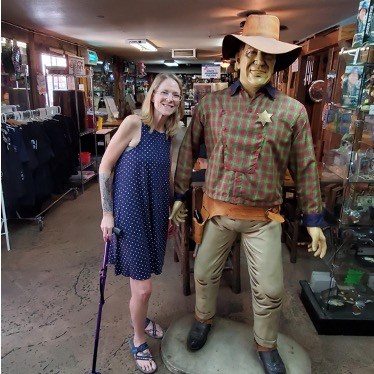
Rachel posing next to a statue of a sheriff at Charlie Brown Farms, a gift shop in Littlerock, CA. circa 2019
In the past 10 years, doctors have discovered that Pompe is not quite as rare as they thought: it’s just that the symptoms can come on at any time, as they did for Rachel and so many others diagnosed with late-onset Pompe. But now that they’ve done so much research into it. They’ve learned to isolate the genes, so now they’re able to locate them, especially in newborns, to stop the muscle weaknessA loss of strength that can affect movement, posture, and sometimes breathing. before it begins. When I asked Rachel what her hopes were for Pompe in the future, this was her reply: “There are lots of positive things to look forward to. There are quite a few large drug companies that are working toward additional treatments. They’re working with gene therapyA developing treatment that aims to fix, replace, or add genetic instructions. and stem cell therapy, and it’s looking pretty positive, but it’s just that it’s crazy to think that there are so many rare diseases out there that you just wouldn’t even think of until it’s thrown in your face.”
For the past 15 years, the Pompe community has grown and expanded worldwide, from Facebook groups and children’s books to annual conferences that take place in April. Together, their voice advocates for the patients who can’t speak up and/or have a much more severe case of Pompe disease. There are 10,000 known rare diseases in the world, some of which still don’t have treatments or cures. Some are invisible unless you’re the one living with it, and others affect people in ways that behave the same as the aftermath of a hip surgery.
“You’re living your life with your young family. And next thing you know, you’re dealt just a blow that you’ve got to deal with devastatingly. Potentially deadly. The illness that you’ve inherited from your parents. You’ve never heard of it, and that just opens your eyes to there being so much out there that you don’t know. My disease, Pompe disease, is just one of millions of rare diseases. There are so many things, and it’s just that.” There is so, so much hope for rare diseases with the advances in technology, and discoveries are happening every day that improve the lives of those suffering from rare diseases.
But another group that people don’t talk about when thinking of debilitating diseases is their caretakers, from spouses to parents, siblings, and anyone close to patients.
This story, this journey, isn’t one of a stranger but my mom’s.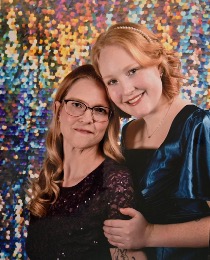
Growing up with a disabled mother was never easy. Due to her diagnosis being so close to my birth date, I spent many years of my life thinking I was the cause of her chronic pain. Times weren’t easy; unlike other mothers and daughters, my mom couldn’t chase me around the park or ride bikes with me.
Without her, I wouldn’t be where I am now, and I wouldn’t change anything. Through her pain, she has taught me resilience, courage, and that despite what life throws at you, you take it in stride and grow. It makes me so incredibly happy to be able to share the journey of her diagnosis and her growth living with Pompe.
My wonderful, beautiful, courageous Mom, who has dealt with more pain than imaginable, I dedicate “Bodysnatcher” to her story.
“A rare disease is a unique chapter in the book of life, written with courage and resilience.” — Emily White
About The Author
Courtney Foster
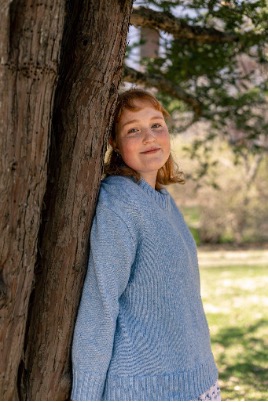
Courtney Foster is an undergraduate student studying communications at Hollins University in Roanoke, Virginia. When not in class, she enjoys singing in her school’s choir and hanging out with her friends.
Contact: Courtney.foster1020@gmail.com