
2021 Helen Walker Research Grant Award
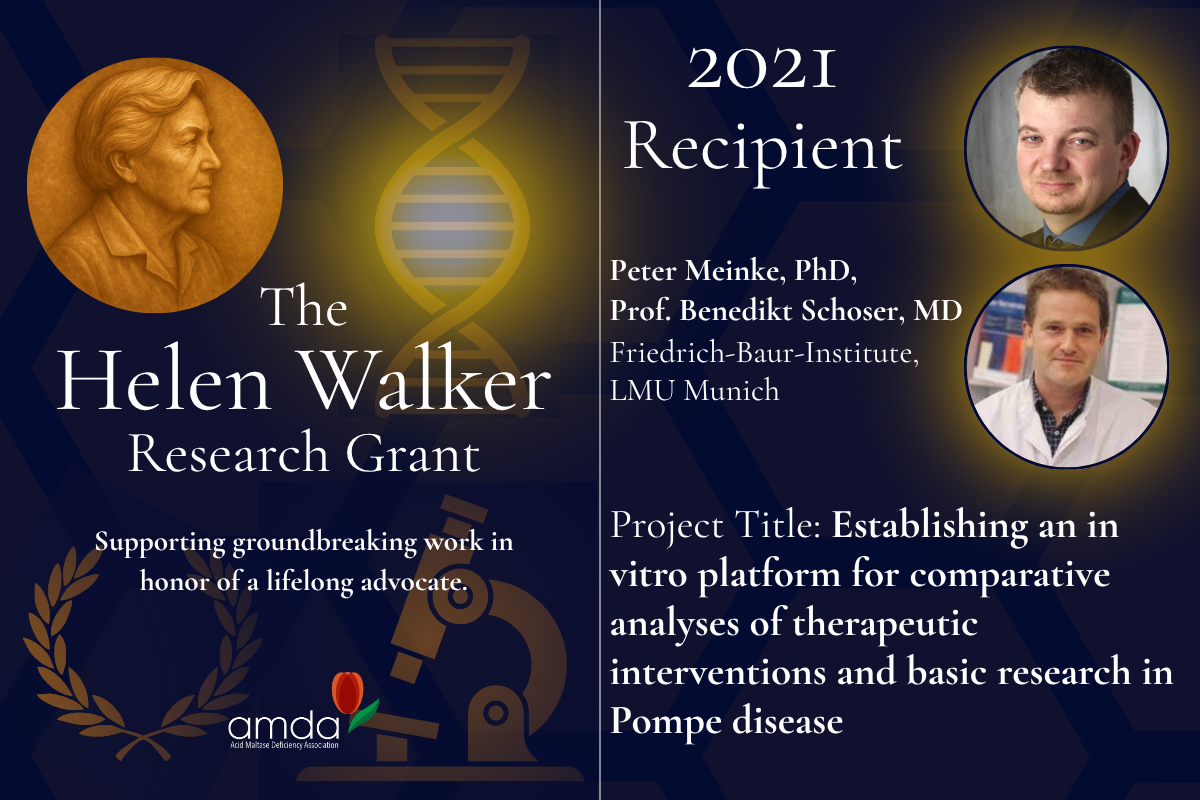
Friedrich-Baur-Institute, LMU Munich | Peter Meinke, PhD; & Prof. Benedikt Schoser, MDSupporting research aimed at improving in vitroA laboratory-based system, such as cells in a dish, used to study diseases and test treatments outside the human body. disease modeling and therapeutic comparison for Pompe diseaseA rare genetic disease in which the body cannot properly break down glycogen, leading to buildup that damages muscles and can affect breathing and, in some cases, the heart..
Quick Facts
Year Awarded:
2021
Funding Amount:
$300,000
Lead Investigators:
Peter Meinke, PhD; & Prof. Benedikt Schoser, MD
Institution:
Friedrich-Baur-Institute, LMU Munich
Research Focus:
ERT optimization and preclinical testing platform
Status:
Ongoing
Project Title
Establishing an in vitro platform for comparative analysis of therapeutic interventions and basic research in Pompe disease
Project Snapshot
In 2021, the AMDA awarded the Helen Walker Research Grant to Peter Meinke, PhD, and Prof. Benedikt Schoser, MD, at the Friedrich-Baur-Institute, LMU Munich, to support a project focused on developing a standardized in vitro platform for Pompe disease research. The project centers on generating and characterizing human muscle cell models derived from individuals with different GAA mutationsThe gene responsible for making the GAA enzyme..
The research aims to create a system that allows direct comparison of therapeutic approaches, including enzymeA protein that helps the body carry out chemical reactions. replacement therapies and emerging treatments. By using patient-derived myoblastsImmature muscle cells that can grow and develop into fully formed muscle fibers. In research, scientists often study myoblasts taken from patients to understand muscle disease and test treatments. and advanced analytical methods, the team is working to evaluate treatment effects on enzyme activity, glycogen accumulationThe buildup of glycogen inside cells and tissues when it is not broken down properly., and gene expressionThe process by which a gene is used to make a protein. in a controlled laboratory setting.
Research Objectives
The project aimed to address several key questions related to treatment outcomes in Pompe disease:
1. Immortalization and characterization of human myoblast cultures
Researchers will create stable muscle cell models by immortalizing primary myoblasts from individuals with Pompe disease and matched controls. These cells will be analyzed in both growth and differentiated states to confirm they accurately reflect disease biology using gene expression, enzyme activity, and glycogenA stored form of sugar used for energy. measurements.
2. Comparative evaluation of enzyme replacement therapies across cell models
The team will compare alglucosidase alfaA form of enzyme replacement therapy used to treat Pompe disease by providing a lab-made version of the GAA enzyme., avalglucosidase alfaA newer enzyme replacement therapy designed to improve delivery of the enzyme to muscle cells., and cipaglucosidase alfaAn investigational enzyme replacement therapy designed to improve enzyme activity in muscles. in the cell platform to assess enzyme uptake, GAA activity, and glycogen clearance. Gene expression analysis will also be used to evaluate how each therapy affects cellular pathways and treatment response.
3. Quantitative analysis of gene expression, enzyme activity, and glycogen content
Researchers will apply RNA sequencingA laboratory technique used to study gene activity by analyzing RNA in cells., GAA activity assays, and glycogen quantification methods to generate consistent, measurable data across models. These analyses will help link molecular changes to treatment outcomes and validate the platform.
4. Development of single-cell glycogen detection using Raman microscopy
Raman microscopy will be used to visualize glycogen in individual cells before and after treatment. This approach allows researchers to observe how therapies affect glycogen clearance at the single-cell level, providing more detailed insight than traditional bulk measurements.
Why This Matters
Pompe disease is caused by a deficiency in the GAA enzyme, leading to glycogen buildup in muscle tissue. Current treatments, such as enzyme replacement therapy, show variable results and often only slow disease progression. This research aims to improve how therapies are evaluated by creating a reliable model system that reflects patient variability. A more accurate testing platform may help guide treatment development, improve comparisons between therapies, and support better clinical decision-making for individuals living with Pompe disease.
Research Team
Institution
Friedrich-Baur-Institute, Ludwig-Maximilians-University Munich, Germany
Technical University of Munich, Germany

Lead Investigator
Peter Meinke, PhD
Research and group leader

Lead Investigator
Prof. Benedikt Schoser, MD
Senior consultant (Oberarzt)
Co-Investigators
Christoph Haisch, PhD
Chair of Analytical Chemistry, Technical University of Munich
Lead Investigator
Peter Meinke, PhD
Research and group leader
Lead Investigator
Prof. Benedikt Schoser, MD
Senior consultant (Oberarzt)
Co-Investigator
Christoph Haisch, PhD
Chair of Analytical Chemistry, Technical University of Munich
Grant Support
The AMDA awarded $300,000 through the Helen Walker Research Grant to support this project.
Funding supported cell cultureA laboratory method used to grow cells outside the body so researchers can study disease and test treatments. systems and laboratory consumables, reagentsSubstances used in laboratory experiments to help detect, measure, or trigger chemical reactions. and assays for GAA activity and glycogen measurement, RNA sequencing analysis, Raman microscopy access, and personnel support for a laboratory technician of PhD student.
Publications Resulting from This Research
This section will be updated as we collect more information about publications resulting from this research.
Related Outputs
This section will be updated as we collect more information about presentations, follow-up studies, or related outputs from this project.
Ongoing Impact
Research supported by the Helen Walker Research Grant helps build knowledge that can shape future studies, clinical care, and treatment strategiesA planned approach to managing disease that may include medicines, monitoring, supportive care, and other therapies. in Pompe disease. As additional publications, presentations, and follow-up work emerge, this page will continue to be updated.
About the Helen Walker Research Grant
The Helen Walker Research Grant honors Helen Walker, a dedicated patient advocateA person who helps patients and families navigate care, information, services, and support. and leader in the Pompe community. Through this grant, the AMDA supports innovative research aimed at improving understanding, treatment, and care for individuals living with Pompe disease.
Explore more Helen Walker Research Grant awardees and the growing body of Pompe research supported by the AMDA.