
2019 Helen Walker Research Grant Award
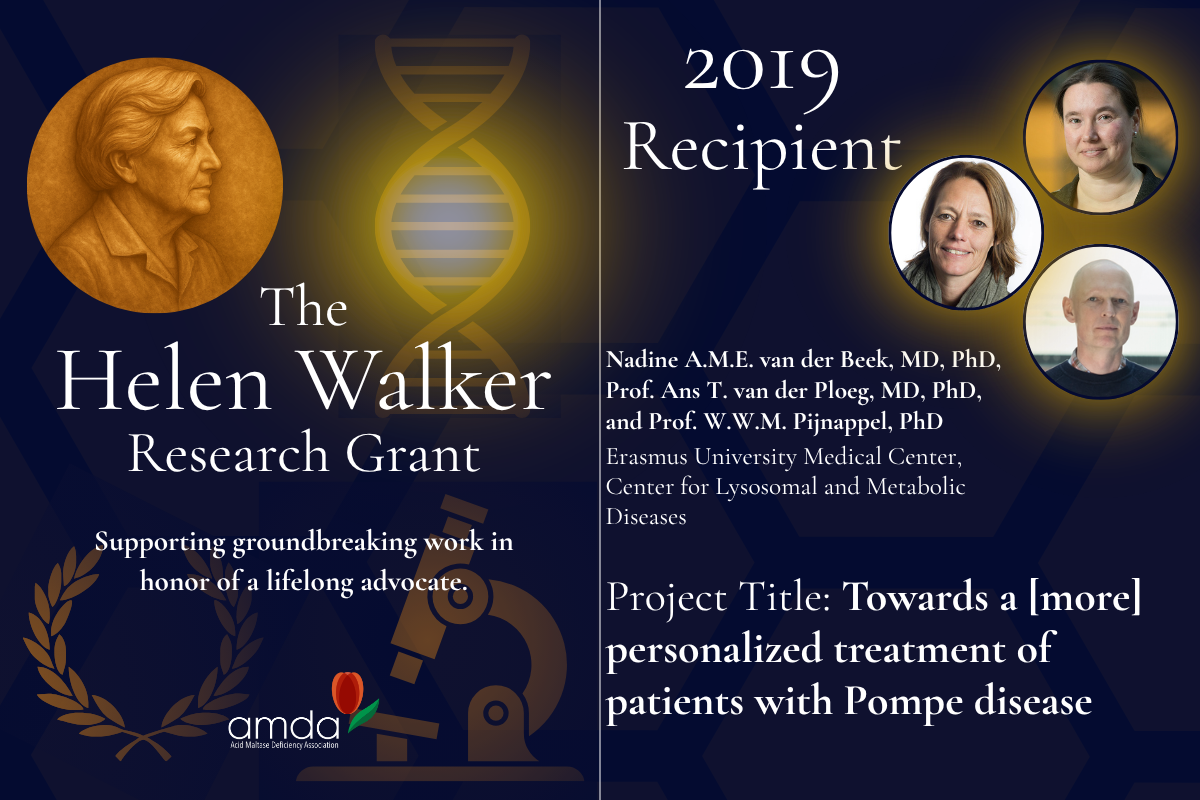
Erasmus University Medical Center | Nadine A.M.E. van der Beek, MD, PhDSupporting research aimed at improving personalized treatment strategiesA planned approach to managing disease that may include medicines, monitoring, supportive care, and other therapies. for Pompe diseaseA rare genetic disease in which the body cannot properly break down glycogen, leading to buildup that damages muscles and can affect breathing and, in some cases, the heart..
Quick Facts
Year Awarded:
2019
Funding Amount:
$200,000
Lead Investigator:
Nadine A.M.E. van der Beek, MD, PhD
Institution:
Erasmus MC University Medical Center — Center for Lysosomal and Metabolic Disease (Rotterdam, The Netherlands)
Research Focus:
ERT optimization and clinical outcomes
Status:
Completed — Publications Resulting from Research
Project Title
Towards a [more] personalized treatment of patients with Pompe disease
Project Snapshot
In 2019, the AMDA awarded the Helen Walker Research Grant to researchers at Erasmus MC University Medical Center in Rotterdam, The Netherlands. The project, led by Nadine A.M.E. van der Beek, MD, PhD, focused on understanding why patients with Pompe disease respond differently to enzyme replacement therapy (ERT)A treatment that replaces the missing enzyme through IV infusion..
Although ERT has significantly improved outcomes for many individuals with Pompe disease, patients often experience varying levels of benefit over time. By studying long-term clinical outcomes, treatment dosing strategies, and biological factors influencing therapy response, the research team aimed to better understand these differences and move toward more personalized treatment strategies for Pompe disease.
Research Objectives
The project aimed to address several key questions related to treatment outcomes in Pompe disease:
1. Define long-term outcomes of enzyme replacement therapy
Researchers examined long-term clinical data to better understand how patients respond to ERT over many years and why responses differ among individuals.
2. Investigate dosing strategies and treatment targeting
The team studied whether higher dosing strategies or improved targeting of the therapeutic enzymeA protein that helps the body carry out chemical reactions. could enhance treatment effectiveness.
3. Improve international treatment guidelines
By integrating clinical data, laboratory research, and patient-reported outcomesInformation about health, symptoms, or quality of life reported directly by patients., the project aimed to help inform improved guidelines for treatment timing and dosing in Pompe disease care.
Why This Matters
Pompe disease affects individuals differently, and responses to enzyme replacement therapy can vary widely. Some patients experience long-term stabilization, while others see reduced benefit over time. Understanding the factors that influence treatment response is essential for improving care.
This research helps move the field toward precision medicine in Pompe disease, where treatment strategies can be tailored to the needs of individual patients. Insights from this work may also inform the development of next-generation therapies currently being explored.
Research Team
Institution
Erasmus University Medical Center
Rotterdam, The Netherlands

Lead Investigator
Nadine A.M.E. van der Beek, MD, PhD
Neurologist — Center for Lysosomal and Metabolic Diseases

Co-Investigator
Prof. Ans T. van der Ploeg, MD, PhD
Chair, Center for Lysosomal and Metabolic Diseases

Co-Investigator
Prof. W.W.M. Pijnappel, PhD
Head, Research Laboratory
Center for Lysosomal and Metabolic Diseases
Lead Investigator
Nadine A.M.E. van der Beek, MD, PhD
Neurologist — Center for Lysosomal and Metabolic Diseases
Co-Investigator
Prof. Ans T. van der Ploeg, MD, PhD
Chair, Center for Lysosomal and Metabolic Diseases
Co-Investigator
Prof. W.W.M. Pijnappel, PhD
Head, Research Laboratory
Center for Lysosomal and Metabolic Diseases
Grant Support
The AMDA awarded $200,000 through the Helen Walker Research Grant to support this project.
Funding supported research personnel, including a PhD researcher and laboratory technician, as well as international collaboration and dissemination of results at scientific meetings.
Publications Resulting from This Research
Research supported through the 2019 Helen Walker Research Grant has contributed to the following peer-reviewed publications.
Improving outcome measures in late onset Pompe disease: Modified Rasch-Built Pompe-Specific Activity scale
van Kooten HA, Horton MC, Wenninger S, et al. Improving outcome measures in late onset Pompe disease: Modified Rash-Built Pompe-Specific Activity scale. European Journal of Neurology. 2024.
Summary
This study evaluated and improved the Rash-Built Pompe-Specific Activity (R-PAct) scale, a patient-reported tool used to measure how Pompe disease affects daily life activities. Using data from more than 500 patients across multiple countries, researchers confirmed that the modified 17-item scale reliably measures two key domains — mobility and activities of daily living. The updated scale provides a more accurate way to track disease progression and treatments outcomes in people with late-onset Pompe diseaseA form of Pompe disease that begins after infancy and usually progresses more slowly..
Read the Article
https://doi.org/10.1111/ene.16397
The impact of COVID-19 infection, the pandemic and its associated control measures on patients with Pompe disease
Theunissen MTM, van den Elsen RM, House TL, et al. The impact of COVID-19 infection, the pandemic and its associated control measures on patients with Pompe disease. Journal of Neurology. 2024;271:32-45.
Summary
This international study examined how COVID-19 infection and the broader pandemic affected people living with Pompe disease. Researchers surveyed 342 patients across 25 countries about infections, treatment disruptions, and the physical and emotional effects of pandemic restrictions. While most COVID-19 infections were mild and resolved within four weeks, many patients reported interruptions in medical care and some experienced disruptions in enzyme replacement therapy. The pandemic also affected mental health and feelings of isolation for many participants, highlighting the importance of maintaining consistent, patient-centered care during global health crises.
Read the Article
https://doi.org/10.1007/s00415-023-11999-2
Related Outputs
This research builds on international collaborations studying the long-term clinical course of Pompe disease and the effects of enzyme replacement therapy across patient populations. Findings from this work contribute to ongoing efforts to improve clinical guidance and future therapeutic strategies.
Ongoing Impact
Research supported by the Helen Walker Research Grant helps build knowledge that can shape future studies, clinical care, and treatment strategies in Pompe disease. As additional publications, presentations, and follow-up work emerge, this page will continue to be updated.
About the Helen Walker Research Grant
The Helen Walker Research Grant honors Helen Walker, a dedicated patient advocateA person who helps patients and families navigate care, information, services, and support. and leader in the Pompe community. Through this grant, the AMDA supports innovative research aimed at improving understanding, treatment, and care for individuals living with Pompe disease.
Explore more Helen Walker Research Grant awardees and the growing body of Pompe research supported by the AMDA.