
2022 Helen Walker Research Grant Award
McMaster University Children's Hospital | Mark Tarnopolsky, BPE, MD, PhDSupporting research aimed at improving biomarker discovery and treatment evaluation through multi-ingredient supplementation for Pompe diseaseA rare genetic disease in which the body cannot properly break down glycogen, leading to buildup that damages muscles and can affect breathing and, in some cases, the heart..
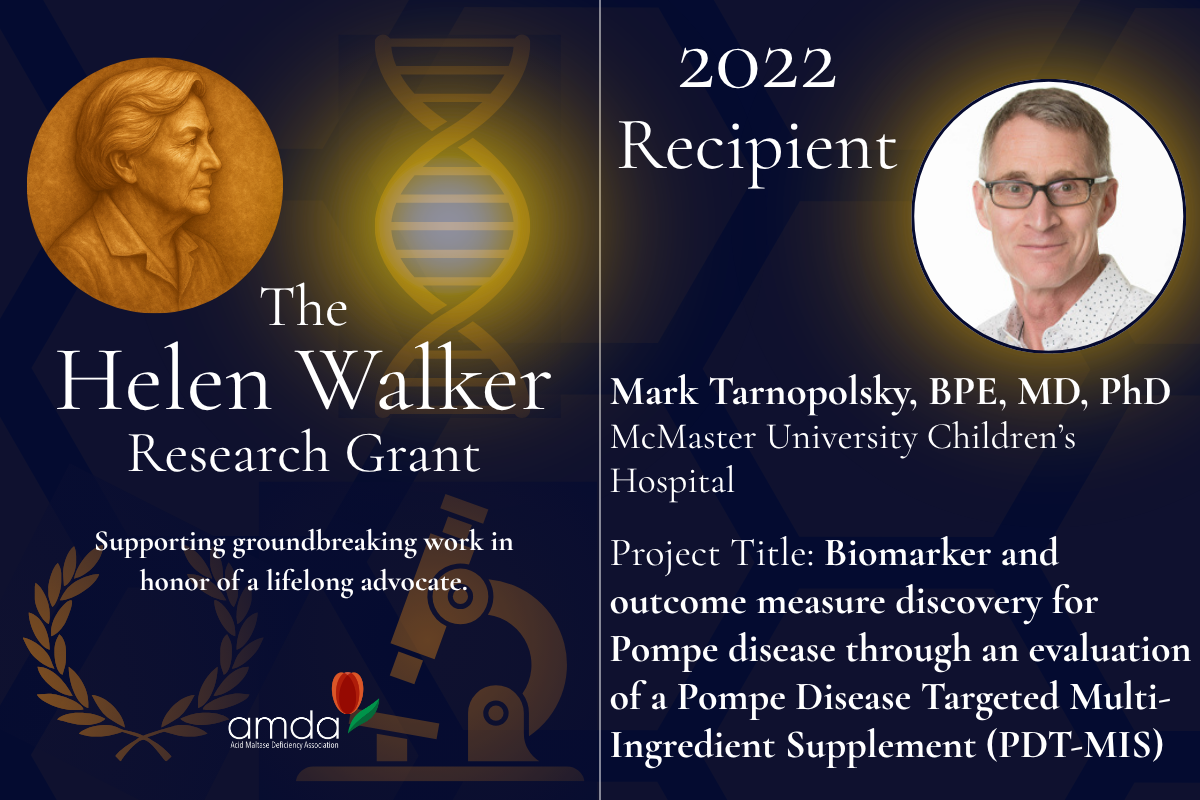
Quick Facts
Year Awarded:
2022
Funding Amount:
$100,000
Lead Investigator:
Mark Tarnopolsky, BPE, MD, PhD
Institution:
McMaster University Children’s Hospital
Research Focus:
ERT optimization, biomarkersA measurable sign in the body that helps track disease progression or treatment response., and digital health innovation
Status:
Ongoing
Project Title
Biomarker and outcome measure discovery for Pompe disease through an evaluation of a Pompe Disease Targeted Multi-Ingredient Supplement (PDT-MIS)
Project Snapshot
In 2022, the AMDA awarded the Helen Walker Research Grant to Mark Tarnopolsky, BPE, MD, PhD, at the Neuromuscular and Neurometabolic Clinic at McMaster University Children’s Hospital, to support a project focused on identifying biomarkers and improving outcome measures in Pompe disease. The project centers on evaluating a Pompe Disease Targeted Multi-Ingredient Supplement (PDT-MIS) alongside clinical and digital health tools.
The research aims to assess how this supplementation approach may impact disease-related pathology, physical function, and overall health. Using a randomized clinical trialA study in which participants are randomly assigned to different treatment groups so outcomes can be compared fairly. design, the study incorporates wearable technology, clinical testing, and biomarker analysis to better understand treatment response and improve how outcomes are measured in Pompe disease.
Research Objectives
The project aimed to address several key questions related to treatment outcomes in Pompe disease:
1. Evaluation of disease pathology and biomarkers
Researchers will assess Pompe disease-relevant biomarkers, including glycogen accumulationThe buildup of glycogen inside cells and tissues when it is not broken down properly., autophagic buildup, mitochondrialParts of the cell that produce energy. dysfunction, oxidative stress, and inflammation, to determine how they change in response to treatment.
2. Assessment of clinical outcomes using functional testing and wearable data
The study will evaluate treatment effects using established clinical measures of body composition, strength, respiratory function, and mobility, alongside wearable technology and AI-driven analysis to capture real-world health and quality-of-life outcomes.
3. Clinical evaluation of multi-ingredient supplementation (PDT-MIS)
Researchers will conduct a randomized, double-blind crossover trial to determine the effectiveness of a Pompe Disease Targeted Multi-Ingredient Supplement (PDT-MIS) in improving disease pathology, physical function, and overall quality of life in individuals with late-onset Pompe diseaseA form of Pompe disease that begins after infancy and usually progresses more slowly..
Why This Matters
Pompe disease leads to progressive muscle damage due to glycogenA stored form of sugar used for energy. accumulation and related cellular dysfunctionWhen cells do not function properly due to internal stress or buildup of substances such as glycogen.. Current treatments, including enzymeA protein that helps the body carry out chemical reactions. replacement therapy, do not fully address all aspects of disease progression or variability in patient response. This research aims to improve how treatments are evaluated by identifying reliable biomarkers and outcome measures while testing a complementary therapeutic strategy. These efforts may lead to more precise monitoring of disease progression and more effective approaches to improving patient health and quality of life.
Research Team
Institution
Neuromuscular and Neurometabolic Clinic, McMaster University Children’s Hospital, Hamilton, Ontario, Canada

Lead Investigator
Mark Tarnopolsky, BPE, MD, PhD
Professor of Pediatrics and Medicine; Director of Neuromuscular and Neurometabolic Clinic
Lead Investigator
Mark Tarnopolsky, BPE, MD, PhD
Professor of Pediatrics and Medicine; Director of Neuromuscular and Neurometabolic Clinic
Grant Support
The AMDA awarded $100,000 through the Helen Walker Research Grant to support this project.
Funding supported patient-related expenditures, including travel, lodging, meals, and study completion reimbursement; supplement manufacture and shipping for PDT-MIS and placebo; wearable technology for data collection (e.g., Fitbit devices); experimental procedures, including blood testing, muscle biopsies, urine analysis, and imaging; and laboratory analyses, including inflammatory marker panels, biochemical assaysA lab test used to measure specific biological or chemical processes in cells or tissues., and microscopy services.
Publications Resulting from This Research
This section will be updated as we collect more information about publications resulting from this research.
Related Outputs
This section will be updated as we collect more information about presentations, follow-up studies, or related outputs from this project.
Ongoing Impact
Research supported by the Helen Walker Research Grant helps build knowledge that can shape future studies, clinical care, and treatment strategiesA planned approach to managing disease that may include medicines, monitoring, supportive care, and other therapies. in Pompe disease. As additional publications, presentations, and follow-up work emerge, this page will continue to be updated.
About the Helen Walker Research Grant
The Helen Walker Research Grant honors Helen Walker, a dedicated patient advocateA person who helps patients and families navigate care, information, services, and support. and leader in the Pompe community. Through this grant, the AMDA supports innovative research aimed at improving understanding, treatment, and care for individuals living with Pompe disease.
Explore more Helen Walker Research Grant awardees and the growing body of Pompe research supported by the AMDA.