
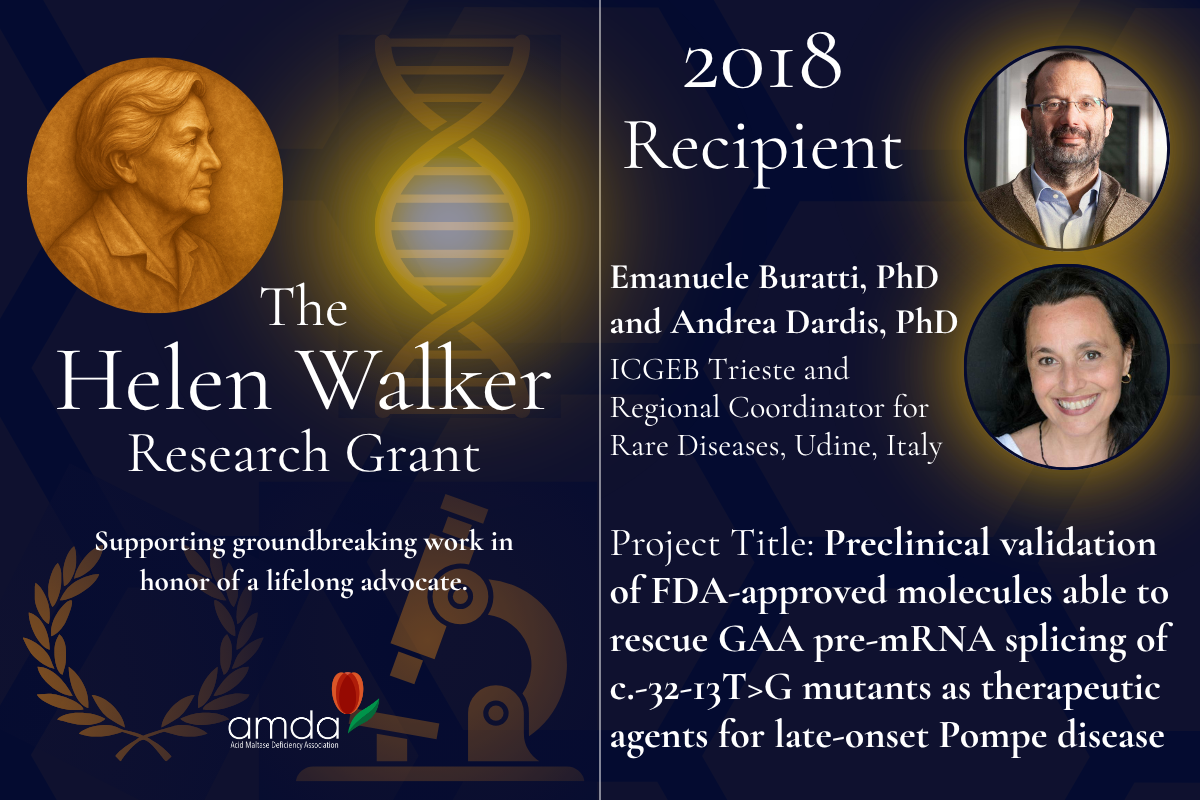
2018 Helen Walker Research Grant Award
International Centre for Genetic Engineering and Biotechnology (ICGEB), Trieste & Regional Coordinator Centre for Rare Diseases, Udine | Emanuele Buratti, PhD, & Andrea Dardis, PhDAdvancing therapeutic strategies to correct RNA splicingA normal step in how the body reads gene instructions. If splicing goes wrong, the wrong protein may be made. defects in late-onset Pome disease.
Quick Facts
Year Awarded:
2018
Funding Amount:
$200,000
Lead Investigator:
Emanuele Buratti, PhD
Andrea Dardis, PhD
Institution:
International Centre for Genetic Engineering and Biotechnology (ICGEB), Trieste, Italy
Regional Coordinator Centre for Rare Diseases, University Hospital of Udine, Italy
Research Focus:
Therapeutic development (mutation-specific treatment)
Status:
Completed — Publications Added
Project Title
Preclinical validation of FDA-approved molecules able to rescue GAA pre-mRNA splicing of c.-32-13T>G mutants as therapeutic agents for late-onset Pompe diseaseA form of Pompe disease that begins after infancy and usually progresses more slowly.
Project Snapshot
In 2018, the AMDA awarded the Helen Walker Research Grant to Emanuele Buratti, PhD, and Andrea Dardis, PhD, at the International Centre for Genetic Engineering and Biotechnology (ICGEB) in Trieste and the Regional Coordinator Centre for Rare Diseases in Udine, Italy, to support a project focused on developing therapeutic strategies that correct RNA splicing defects in Pompe diseaseA rare genetic disease in which the body cannot properly break down glycogen, leading to buildup that damages muscles and can affect breathing and, in some cases, the heart..
The goal of the project was to identify FDA-approved small molecules capable of restoring correct splicing of the GAA geneThe gene responsible for making the GAA enzyme. in patients carrying the common c.-32-13T>G mutationA change in a gene that can affect how it works., a genetic variant responsible for many cases of late-onset Pompe disease. The team developed a fluorescent screening system to identify compounds that could improve exon 2 inclusion and increase functional enzymeA protein that helps the body carry out chemical reactions. activity in patient-derived cells.
Research Objectives
The project aimed to address several key questions related to treatment outcomes in Pompe disease:
1. Validate small molecules that restore correct GAA exon 2 splicing
The project sought to confirm whether the most promising compounds identified through high-throughput screening could reliably improve exon 2 inclusing in GAA transcripts carrying the c.-32-13T>G mutation. Experiments were designed to measure changes in RNA splicing and enzyme activity following treatment with candidate molecules.
2. Assess therapeutic effects in Pompe disease patient-derived muscle cells
Researchers planned to test the identified compounds in myotubesDeveloping muscle fibers formed when myoblasts fuse together. In research, myotubes are used to study how muscle cells function and respond to treatments in Pompe disease. derived from patient muscle cells, which better mimic the biological environment of skeletal muscleMuscles that control movement and are commonly affected in Pompe disease. affected by Pompe disease. These studies evaluated the effects of candidate molecules on GAA activity and glycogenA stored form of sugar used for energy. storage in relevant disease models.
3. Identify molecular pathways involved in splicing correction
In addition to validating the lead compound, the team aimed to investigate the cellular pathways responsible for improved exon inclusion. Understanding the mechanism of action could help identify additional drugs that influence the same pathways and potentially enhance therapeutic outcomes.
Why This Matters
This research matters because many individuals with late-onset Pompe disease carry the c.-32-13T>G mutation which disrupts normal RNA splicing of the GAA gene and reduces production of the functional enzyme needed to break down glycogen. Even modest improvements in exon inclusion could significantly increase enzyme activity and improve disease outcomes.
By studying therapeutic approaches that restore correct RNA splicing, the team aimed to better understand how existing FDA-approved drugs might be repurposed to improve treatment strategiesA planned approach to managing disease that may include medicines, monitoring, supportive care, and other therapies., clinical decision-making, and future research for people living with Pompe disease.
Research Team
Institution
International Centre for Genetic Engineering and Biotechnology (ICGEB), Trieste, Italy
Regional Coordinator Centre for Rare Diseases, University Hospital of Udine, Italy

Lead Investigator
Emanuele Buratti, PhD
Group Leader, Molecular Pathology Laboratory

Co-Investigator
Andrea Dardis, PhD
Head of Laboratory, Regional Coordinator Centre for Rare Diseases
Lead Investigator
Emanuele Buratti, PhD
Group Leader, Molecular Pathology Laboratory
Co-Investigator
Andrea Dardis, PhD
Head of Laboratory, Regional Coordinator Centre for Rare Diseases
Grant Support
The AMDA awarded $200,00 through the Helen Walker Research Grant to support this project.
Funding supported laboratory personnel, experimental materials and consumables, RNA sequencingA laboratory technique used to study gene activity by analyzing RNA in cells. analysis, and specialized muscle cell cultureA laboratory method used to grow cells outside the body so researchers can study disease and test treatments. work needed to evaluate candidate therapeutic compounds.
Publications Resulting from This Research
Research supported through the 2018 Helen Walker Research Grant has contributed to the following peer-reviewed publications.
”Deferoxamine
Buratti E, Peruzzo P, Braga L, et al. Deferoxamine mesylate improves splicing and GAA activity of the common c.-32-13T>G allele in late-onset Pompe disease patient fibroblasts. Molecular Therapy: Methods & Clinical Development. 2021.
Summary
This publication explores how the FDA-approved drug deferoxamine can improve RNA splicing of the GAA gene in cells carrying the c.-32-13T>G mutation. Treatment increased exon 2 inclusion and improved enzyme activity in patient fibroblasts, supporting the potential for drug repurposing approaches in Pompe disease.
Read the Article
https://amda-pompe.org/wp-content/uploads/2026/03/DEFEROXAMINE-MESYLATE-IMPROVES-SPLICING.pdf
Rescue of common and rare exon 2 skipping variants of the GAA gene using modified U1 snRNA
Rescue of common and rare exon 2 skipping variants of the GAA gene using modified U1 snRNA. Molecular Medicine. 2025.
Summary
This publication explores the use of engineered U1 snRNA molecules designed to restore correct RNA splicing of the GAA gene. The approach increased normal transcript production and improved enzyme activity in patient-derived cells, demonstrating a potential RNA-based therapeutic strategy for Pompe disease.
Read the Article
https://amda-pompe.org/wp-content/uploads/2026/03/RESCUE-OF-COMMON-AND-RARE-EXON.pdf
Related Outputs
- Follow-up studies investigating RNA splicing correction strategies in Pompe disease — 2021-2025
- Continued research on exon-2 splicing mechanisms in the GAA gene
Ongoing Impact
Research supported by the Helen Walker Research Grant helps build knowledge that can shape future studies, clinical care, and treatment strategies in Pompe disease. As additional publications, presentations, and follow-up work emerge, this page will continue to be updated.
About the Helen Walker Research Grant
The Helen Walker Research Grant honors Helen Walker, a dedicated patient advocateA person who helps patients and families navigate care, information, services, and support. and leader in the Pompe community. Through this grant, the AMDA supports innovative research aimed at improving understanding, treatment, and care for individuals living with Pompe disease.
Explore more Helen Walker Research Grant awardees and the growing body of Pompe research supported by the AMDA.