
2016 Helen Walker Research Grant Award
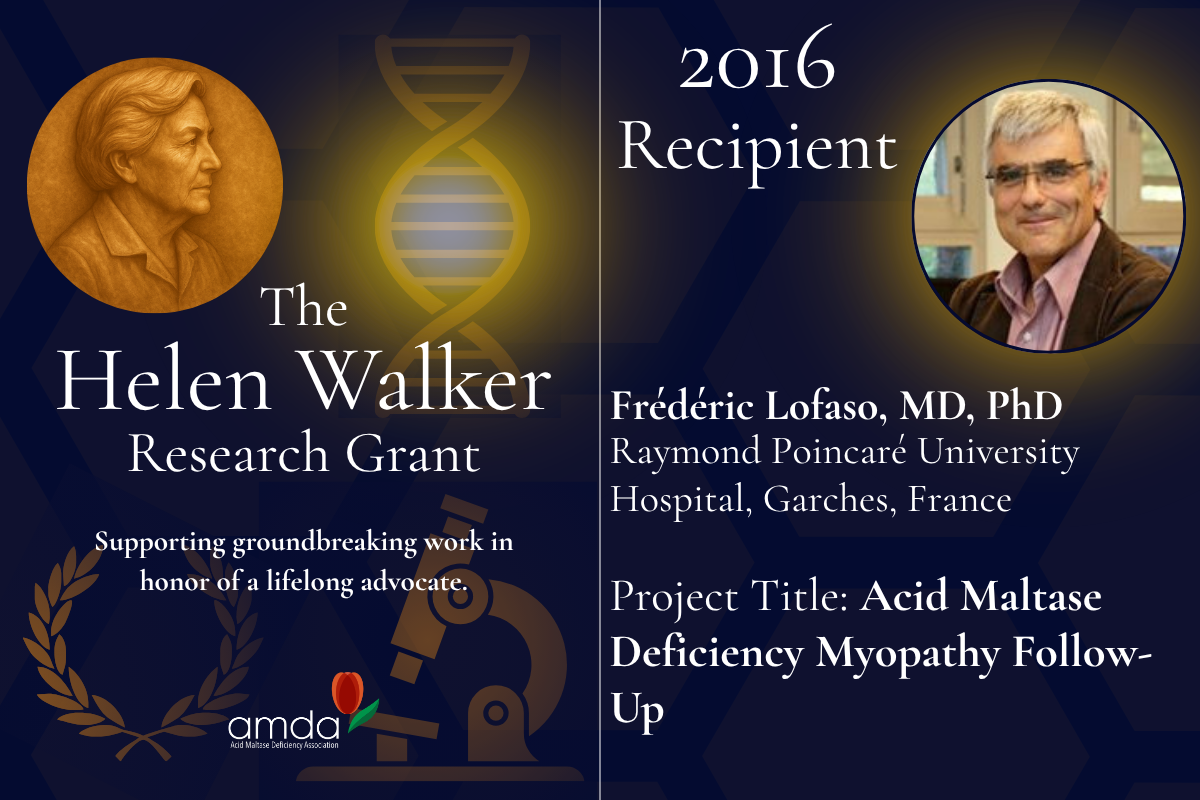
Raymond Poincaré University Hospital | Frédéric LofasoSupporting research aimed at improving clinical outcome measures for late-onset Pompe diseaseA rare genetic disease in which the body cannot properly break down glycogen, leading to buildup that damages muscles and can affect breathing and, in some cases, the heart..
Quick Facts
Year Awarded:
2016
Funding Amount:
$160,000
Lead Investigator:
Frédéric Lofaso, MD, PhD
Institution:
Raymond Poincaré University Hospital, Versailles Saint-Quentin-en-Yvelines University, Garches, France
Research Focus:
Clinical care and diagnostics
Status:
Completed
Project Title
Acid Maltase Deficiency Myopathy Follow-Up
Project Snapshot
In 2016, the AMDA awarded the Helen Walker Research Grant to Frédéric Lofaso, MD, PhD, at Raymond Poincaré University Hospital and Versailles Saint-Quentin-en-Yvelines University, to improve the clinical monitoring of individuals with late-onset Pompe disease (LOPD)A form of Pompe disease that begins after infancy and usually progresses more slowly..
At the time, several emerging therapeutic strategies — including antisense oligonucleotide approaches designed to correct RNA splicingA normal step in how the body reads gene instructions. If splicing goes wrong, the wrong protein may be made. defects in the GAA geneThe gene responsible for making the GAA enzyme. — were being developed. However, one major challenge in evaluating new treatments is the lack of sensitive clinical outcome measures capable of detecting meaningful changes over short time periods.
Current tools used in clinical practice, such as the six-minute walk test and forced vital capacityA breathing test that measures how much air a person can forcefully exhale. measurements, can fail to capture subtle disease progression or early treatment effects. The goal of this project was therefore to develop and implement more precise, non-invasive outcome measures to better monitor disease progression and prepare for future clinical trialsA research study that tests new treatments or approaches in people..
The study proposed a two-year observational follow-up of at least 30 adults with late-onset Pompe disease, incorporating a comprehensive set of physiological and imaging assessments designed to evaluate respiratory function, muscle strength, gait patterns, muscle integrity, and body composition.
Research Objectives
The project aimed to address several key questions related to treatment outcomes in Pompe disease:
1. Improve clinical follow-up of late-onset Pompe disease using innovative non-invasive outcome measures
Researchers proposed adding a set of robust physiological and imaging assessments to the routine clinical monitoring of adults with Pompe disease. These included diaphragmatic functionHow well the diaphragm works during breathing. measurements, neuromuscular fatigueA decrease in muscle performance caused by repeated use or weakness of nerve-muscle signaling. testing, gait analysisThe study of how a person walks using motion tracking. using 3D motion systems, whole-body muscle MRIAn imaging technique that evaluates muscle condition across the entire body., DEXAAn imaging test used to measure body composition such as muscle and bone mass. scanning, and postural analysis using low-dose EOS imaging. By integrating these tools into a two-year observational study of at least 30 patients, the project aimed to establish more sensitive biomarkersA measurable sign in the body that helps track disease progression or treatment response. of disease progression that could be used to evaluate future therapies in clinical trials.
Why This Matters
Pompe disease in adults often progresses slowly, making it difficult to measure meaningful changes in muscle strength or respiratory function over short periods of time. This presents a challenge when designing clinical trials for new therapies, which typically require measurable improvements within one or two years.
By developing more sensitive outcome measures — including advanced imaging, respiratory physiology testing, and biomechanical analysisThe study of movement, posture, and forces in the body. — this research aimed to provide clinicians and researchers with improved tools for tracking disease progression and evaluating the effectiveness of emerging treatments.
Research Team
Institution
Raymond Poincaré University Hospital, Versailles Saint-Quentin-en-Yvelines University, Garches, France
Lead Investigator
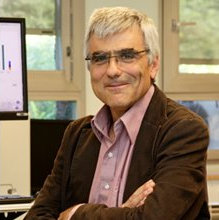
Frédéric Lofaso, MD, PhD
Professor of Physiology
Key Collaborators
Luis Garcia – Preclinical research leadership
Helge Amthor – Translational research coordination
Pascal Laforêt – Clinical recruitment and neuromuscualr evaluation
David Orlikowski – Clinical recruitment
Djillali Annane – Clinical research coordination
Robert Carlier – Muscle MRI analysis
Nicolas Roche – 3D gait analysis
Additional collaborators contributed expertise in respiratory physiology, imaging, biomechanics, and neuromuscular assessment.
Lead Investigator
Frédéric Lofaso, MD, PhD
Professor of Physiology
Key Collaborators
Luis Garcia – Preclinical research leadership
Helge Amthor – Translational research coordination
Pascal Laforêt – Clinical recruitment and neuromuscualr evaluation
David Orlikowski – Clinical recruitment
Djillali Annane – Clinical research coordination
Robert Carlier – Muscle MRI analysis
Nicolas Roche – 3D gait analysis
Additional collaborators contributed expertise in respiratory physiology, imaging, biomechanics, and neuromuscular assessment.
Grant Support
The AMDA awarded $160,000 through the Helen Walker Research Grant to support this project.
Funding supported advanced physiological testing, imaging studies such as whole-body muscle MRI and DEXA scans, biomechanical gait analysis, data management, and research coordination required to conduct the multi-year observational study.
Publications Resulting from This Research
This section will be updated as we collect more information about publications resulting from this research.
Related Outputs
This section will be updated as we collect more information about presentations, follow-up studies, or related outputs from this project.
Ongoing Impact
Research supported by the Helen Walker Research Grant helps build knowledge that can shape future studies, clinical care, and treatment strategiesA planned approach to managing disease that may include medicines, monitoring, supportive care, and other therapies. in Pompe disease. As additional publications, presentations, and follow-up work emerge, this page will continue to be updated.
About the Helen Walker Research Grant
The Helen Walker Research Grant honors Helen Walker, a dedicated patient advocateA person who helps patients and families navigate care, information, services, and support. and leader in the Pompe community. Through this grant, the AMDA supports innovative research aimed at improving understanding, treatment, and care for individuals living with Pompe disease.
Explore more Helen Walker Research Grant awardees and the growing body of Pompe research supported by the AMDA.