
2015 Helen Walker Research Grant Award
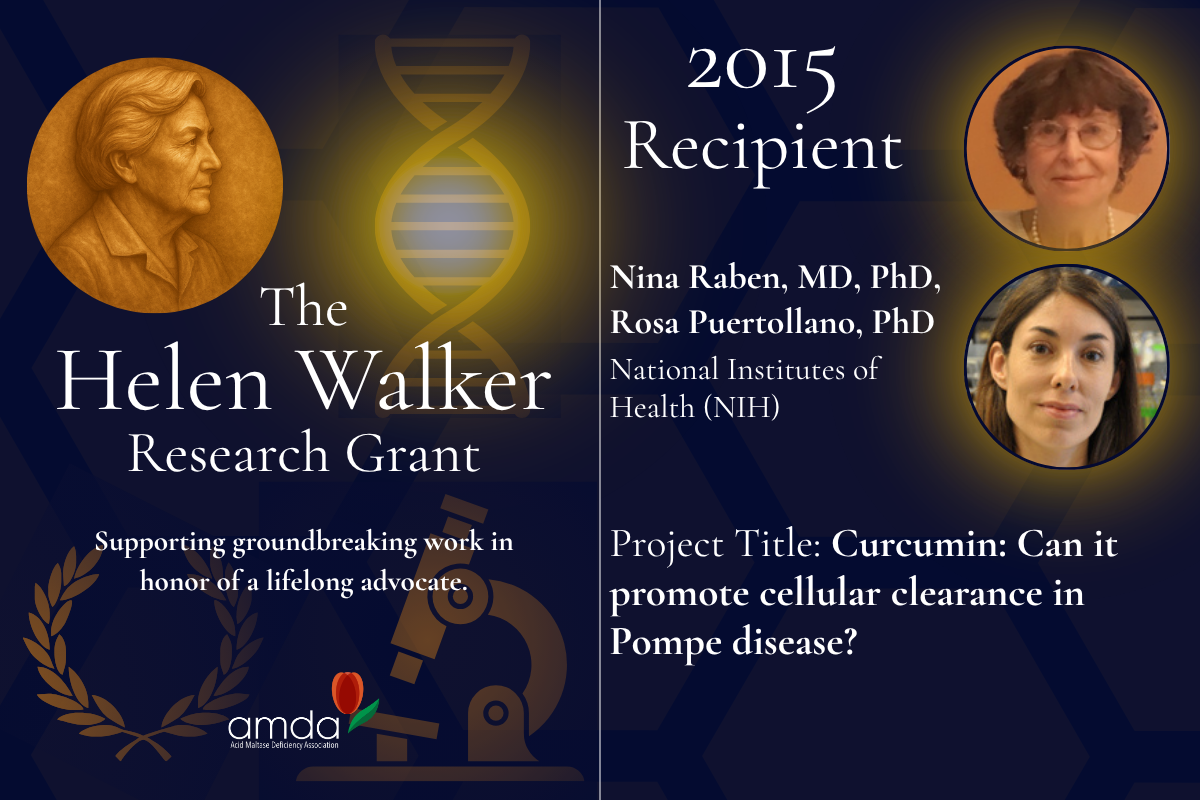
National Institutes of Health (NIH) | Nina Raben, MD, PhD, & Rosa Puertollano, PhDSupporting research exploring curcuminA natural compound being studied for its potential role in supporting cellular processes. as a complementary therapeutic strategy for Pompe diseaseA rare genetic disease in which the body cannot properly break down glycogen, leading to buildup that damages muscles and can affect breathing and, in some cases, the heart..
Quick Facts
Year Awarded:
2015
Funding Amount:
$140,000
Lead Investigators:
Nina Raben, MD, PhD; Rosa Puertollano, PhD
Institution:
National Institutes of Health (NIH)
Research Focus:
Therapeutic development and ERT optimization
Status:
Completed
Project Title
Curcumin: Can it promote cellular clearanceThe process by which cells remove waste and damaged materials. in Pompe disease?
Project Snapshot
In 2015, the AMDA awarded the Helen Walker Research Grant to Nina Raben, MD, PhD, and colleagues at the National Institute of Arthritis and Musculoskeletal and Skin Diseases (NIAMS) and the National Heart, Lung, and Blood Institute (NHLBI) at the National Institutes of Health, to support a project exploring curcumin as a complementary therapeutic strategy for Pompe disease. The goal of the project was to determine whether this natural compound, derived from the spice turmeric, could activate a transcription factorA protein that helps control whether a gene is turned on or off. called TFE3 to promote cellular clearance — addressing not only the primary enzymeA protein that helps the body carry out chemical reactions. deficiency but also the secondary cellular abnormalities that enzyme replacement therapy alone cannot resolve.
The team used both diseased cultured muscle cells and Pompe mouse modelsA laboratory mouse used to study disease and test treatments before human trials. to test the effects of curcumin on lysosomal exocytosisThe process by which a cell releases materials outside of itself., autophagic buildup, mitochondrialParts of the cell that produce energy. function, and calcium regulation. Preliminary studies had already shown that curcumin could stimulate TFE3 activation and promote the removal of accumulated lysosomal material from Pompe muscle cells. Beyond its potential to clear cellular debris, curcumin was also expected to help address muscle atrophy — a persistent feature of Pompe disease — making it a candidate for use alongside existing enzyme replacement treatment.
Research Objectives
The project aimed to address several key questions related to treatment outcomes in Pompe disease:
1. Evaluate the therapeutic efficacy of curcumin in mouse models of Pompe disease
Researchers proposed feeding curcumin to Pompe disease mouse models to determine whether the compound could improve muscle pathology and overall physical performance. The study examined effects on glycogen accumulationThe buildup of glycogen inside cells and tissues when it is not broken down properly., lysosomal size, autophagic buildup, mitochondrial function, calcium regulation, muscle strength, and endurance in treated animals.
2. Determine the molecular mechanism of curcumin-mediated activation of TFE3 in muscle cells
The research team planned to investigate how curcumin activates the transcription factor TFE3 and promotes lysosomal exocytosis in Pompe muscle cells. Using cultured GAA-deficient myotubesDeveloping muscle fibers formed when myoblasts fuse together. In research, myotubes are used to study how muscle cells function and respond to treatments in Pompe disease., the study aimed to identify signaling pathways involved in TFE3 activation and map the gene networks responsible for lysosomal and autophagic biogenesis.
Why This Matters
Pompe disease is characterized not only by glycogenA stored form of sugar used for energy. accumulation but also by secondary cellular abnormalities that interfere with normal muscle function. These include defective autophagyThe cell's internal cleanup system that removes damaged or unneeded material., abnormal mitochondria, and disrupted calcium regulation.
By targeting cellular clearance pathways through activation of the transcription factor TFE3, this research aimed to address both the primary and secondary pathological processesThe series of changes in the body that occur as a disease develops and progresses. in Pompe disease. If successful, curcumin — or related compounds that activate the same pathway — could potentially serve as a complementary therapy alongside enzyme replacement treatment.
Research Team
Institution
National Institutes of Health, United States

Lead Investigator
Nina Raben, MD, PhD
Staff Scientist, National Institute of Arthritis and Musculoskeletal and Skin Diseases (NIAMS), NIH
Collaborator
Rosa Puertollano, PhD
Senior Investigator, National Heart, Lung, and Blood Institute (NHLBI), NIH
Research Staff
Lishu Li, PhD – Research Fellow
Jeong-A Lim, PhD – Postdoctoral Fellow
Lead Investigator
Nina Raben, MD, PhD
Staff Scientist, National Institute of Arthritis and Musculoskeletal and Skin Diseases (NIAMS), NIH
Collaborator
Rosa Puertollano, PhD
Senior Investigator, National Heart, Lung, and Blood Institute (NHLBI), NIH
Research Staff
Lishu Li, PhD – Research Fellow
Jeong-A Lim, PhD – Postdoctoral Fellow
Grant Support
The AMDA awarded $140,000 through the Helen Walker Research Grant to support this project.
Funding supported research personnel, laboratory reagentsSubstances used in laboratory experiments to help detect, measure, or trigger chemical reactions. for cell cultureA laboratory method used to grow cells outside the body so researchers can study disease and test treatments. experiments, maintenance of Pompe disease mouse models, behavioral and physiological testing of animals, and analysis of muscle tissue and cellular pathways involved in lysosomal clearance.
Publications Resulting from This Research
This section will be updated as we collect more information about publications resulting from this research.
Related Outputs
This section will be updated as we collect more information about presentations, follow-up studies, or related outputs from this project.
Ongoing Impact
Research supported by the Helen Walker Research Grant helps build knowledge that can shape future studies, clinical care, and treatment strategiesA planned approach to managing disease that may include medicines, monitoring, supportive care, and other therapies. in Pompe disease. As additional publications, presentations, and follow-up work emerge, this page will continue to be updated.
About the Helen Walker Research Grant
The Helen Walker Research Grant honors Helen Walker, a dedicated patient advocateA person who helps patients and families navigate care, information, services, and support. and leader in the Pompe community. Through this grant, the AMDA supports innovative research aimed at improving understanding, treatment, and care for individuals living with Pompe disease.
Explore more Helen Walker Research Grant awardees and the growing body of Pompe research supported by the AMDA.